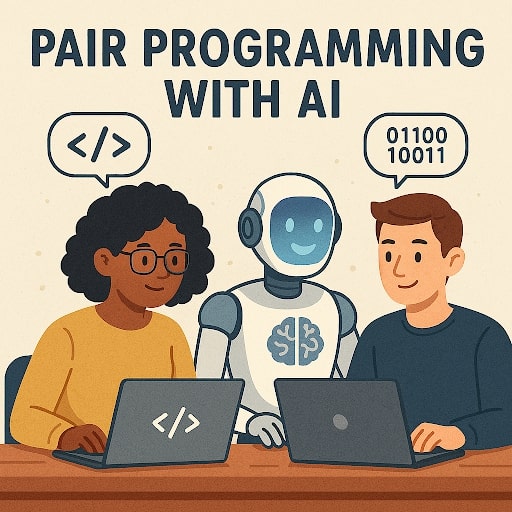
For decades, pair programming was the gold standard of collaborative software engineering. It involved two humans, one keyboard, and a constant stream of dialogue. One acted as the "driver," writing the code, while the other was the "navigator," scanning for bugs, thinking about the big picture, and suggesting architectural improvements.
As we move through 2025 and into 2026, the "navigator" in that seat is increasingly likely to be an Artificial Intelligence. AI pair programming has transitioned from a novel experiment to a foundational infrastructure for modern development. But simply having an AI assistant open in your IDE isn't "pairing." To truly harness this technology, developers must shift their mindset from using a tool to collaborating with a partner.
The Evolution of the Partnership
Traditional pair programming was valued because it produced code with fewer defects and shared knowledge across a team. However, it was also expensive and socially taxing. AI pair programming offers a different value proposition. It provides an "always-on" collaborator with infinite patience, a perfect memory of documentation, and the ability to context-switch across dozens of programming languages instantly.
In the current landscape, the roles have shifted significantly:
- The AI (The Driver): Handles the syntax, generates boilerplate, suggests refactoring patterns, and interprets complex error logs.
- The Human (The Navigator): Directs the overall strategy, makes high-level architectural decisions, ensures alignment with business requirements, and most importantly acts as the final arbiter of quality and ethics.
1. The Power of Conversational Coding
The most significant shift in 2026 is the move from "autocomplete" to "reasoning." Early versions of AI tools were essentially enhanced predictive text. Today, advanced large language models allow for a deep, technical dialogue.
Effective AI pairing involves Iterative Refinement. Instead of asking for a finished product, savvy developers use a "sandwich" approach:
- Context Setting: Share the specific project constraints, library versions, and coding standards.
- The Ask: Request a rough implementation or a draft of the logic.
- The Critique: Point out edge cases or performance bottlenecks the AI missed, asking it to refactor accordingly.
This back-and-forth simulates the "rubber ducking" effect of human pairing, where explaining the problem helps the human discover their own logic gaps.
2. Boosting Productivity: Beyond the Boilerplate
Statistics show that developers using AI assistants complete tasks significantly faster. But speed isn't just about typing fewer characters. AI pair programming transforms the Software Development Lifecycle (SDLC) in three key areas:
- Unit Testing & QA: AI is exceptionally good at writing comprehensive test suites. It can look at a function and instantly generate the "happy path" tests, edge cases, and failure mocks that humans often find tedious.
- Documentation-as-Code: The era of outdated documentation is ending. AI partners can maintain living documentation, updating READMEs and JSDoc comments in real-time as the code evolves.
- Legacy Modernization: One of the greatest advantages of an AI partner is its ability to explain decades-old COBOL or undocumented Java monoliths and suggest a step-by-step refactoring plan into modern microservices.
3. The Productivity-Quality Paradox
While velocity is up, a dangerous trend has emerged: the rise of code churn. Recent industry studies show that while more code is being written, more of it is being reverted within short windows. This is the "Productivity-Quality Paradox." Because it is so easy to generate code, developers are tempted to approve suggestions they don't fully understand.
To combat this, elite engineering teams are implementing Mandatory Dual Review policies. Even if an AI writes the code, it must be vetted by a human who can explain why it works. If you can't explain the AI's output, you shouldn't merge it.
4. Navigating the Security Landscape
Pairing with AI brings new risks. Prompt Injection and Model Poisoning are now legitimate security concerns. An AI might suggest a code snippet that works perfectly but contains a subtle SQL injection vulnerability or uses a deprecated, insecure library.
Your AI partner is trained on the internet, which contains a vast amount of legacy or insecure code. Therefore, the "Navigator" role must include a security-first mindset:
- Contextual Isolation: Use enterprise-grade tools that do not train on your proprietary data.
- Automated Audits: Pair your AI generator with an AI security auditor to create a system of checks and balances.
5- Comparison: Traditional vs. AI Pair Programming
To understand how the landscape has changed, we can look at the key differences between working with a human partner versus an AI assistant:
1. Availability and Scheduling
- Traditional: You are limited by your partner’s schedule. You have to coordinate time zones, coffee breaks, and meeting conflicts.
- AI-Assisted: Your partner is available 24/7. It never gets tired, doesn’t need lunch breaks, and provides instant feedback at 3:00 AM.
2. Deep Context vs. Broad Knowledge
- Traditional: A human partner understands the "why." They know the business goals, the specific needs of your customers, and the "tribal knowledge" of the company that isn't written down.
- AI-Assisted: The AI knows the "how." It has been trained on billions of lines of code and documentation across almost every programming language. While it might not know your specific business secrets, it knows the best syntax for a complex library instantly.
3. Social and Mental Energy
- Traditional: Pairing with a human can be socially exhausting. It requires constant communication, which can lead to "zoom fatigue" or burnout after a few hours.
- AI-Assisted: There is zero social cost. You can be as blunt as you want, ask "stupid" questions without judgment, and turn the assistant off the moment you want to work solo.
4. Mentorship and Growth
- Traditional: This is a two-way street. A senior developer can mentor a junior, passing on soft skills, career advice, and high-level problem-solving techniques.
- AI-Assisted: This is primarily a one-way tool. While the AI can explain code, it doesn’t "learn" from you or grow as a teammate. It is an assistant, not a protégé.
5. Architectural Vision
- Traditional: Humans excel at long-term thinking. A human partner can warn you that a specific shortcut today will cause a massive headache for the team six months from now.
- AI-Assisted: AI is often focused on the "now." While its context window is growing, it can still struggle to see how a small function in one file impacts the entire global architecture of a massive system.
6. Future Outlook: Agentic AI in 2026
We are currently moving from AI assistants to Agentic AI Coworkers. In the near future, your AI pair programmer won't just wait for your prompt. It will:
- Proactively monitor project management tools for new tickets.
- Scaffold entire branches and create draft Pull Requests (PRs) before a human starts the task.
- Run the CI/CD pipeline and suggest fixes for its own failing tests.
In this world, the human developer's role moves even further up the stack. We are becoming Systems Orchestrators rather than code writers. The value of a developer will be measured not by their ability to memorize syntax, but by their ability to solve complex business problems using AI as a high-velocity engine.
Conclusion: The New Craftsmanship
Pair programming with AI is not the end of "real" coding; it is the beginning of a new era of craftsmanship. The best developers today are those who treat their AI as a brilliant, slightly over-eager junior developer who needs constant, high-level guidance.
By mastering the art of the prompt, maintaining a rigorous review process, and focusing on the architectural "why" instead of the syntactical "how," you can transform your development workflow from a solitary grind into a high-speed, collaborative journey.